
Filed November 3, 2026
California
Twenty-eight charged. Then twelve more.
CalMatters went to court. The first defendant up was Camilo Giles Jimenez, 51, a lawful permanent resident from Mexico, a business owner and a father of seven. He has lived outside Kerman, in Fresno County, since at least 2017. On a Wednesday he pleaded not guilty in federal court in downtown Fresno to three misdemeanor counts. The charge is that he voted in three elections. A noncitizen cannot vote for president or for Congress. The complaint says he sent a registration to the Fresno County registrar in 2022 and checked the box that says he is a U.S. citizen. He told agents he registered after he got his green card and had been voting since 2023, and he denied claiming he was a citizen. His public defender, Erin Snider, said he owns a paving company. He did not talk to the reporters. Neither did she.
He is one of 28 California residents the Justice Department charged on October 19, in a sweep it called Operation Protect the Vote. Acting Deputy Attorney General Trent McCotter said the charges are some combination of unlawful voting by an alien, a false claim of citizenship in order to vote or to register, and knowingly depriving California residents of a fair election. The department said all 28 are lawful permanent residents. Many of them are not charged with casting a ballot. They are charged with registering, or with lying on a naturalization application. McCotter’s line in the release: “Every illegal vote cancels out the vote of a lawful American citizen.” The other line: “Each of the 28 defendants charged today appears on the list of more than 20,000 likely noncitizen registrants we provided to California election officials last week. California refused to look at that list.”
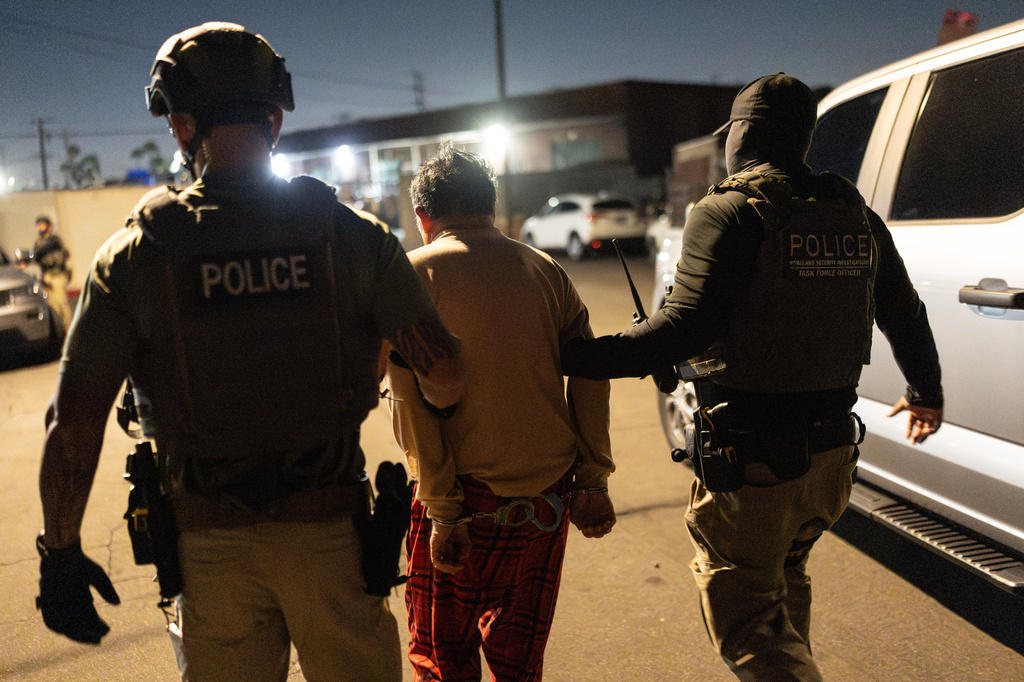
Omar Muñoz, 72, of Commerce, was arrested at his house around 5 a.m. that Monday. CalMatters and the Associated Press put six police vehicles, a helicopter, and a pack of reporters on the street. He was walked out in pajamas, shackled, and taken to downtown Los Angeles. He was out that afternoon. He told KCRW, “It’s a show,” and “I said, ‘Wow!’ I said, ‘I’m not a killer.’” He would not talk about the charge. Kamlesh Shah, 68, told KCRA he thought a Real ID meant he could vote. That is what he said. It is not a defense the complaint has to accept, and it is not a finding.
The list of 20,000 is a separate claim from the 28 names. McCotter said Homeland Security built it by crossing California’s public voter rolls with other government databases, then knocking off anyone with a passport, a Social Security record, an alien file, derivative citizenship, or a naturalization. What was left, he said, was checked by hand. Los Angeles County Registrar Dean Logan told a court that only 7,035 of the 20,000 had addresses in the county, and that some were duplicates. County lawyers called the list unreliable, and said some of the names appear to be U.S.-born. Monica Flores, in the L.A. County registrar’s office, said staff had gone through a sample of 200. The next day the Los Angeles Times reported that a USCIS official, Bartell, had written that the review was still going and that another 17,000 California records might be tied to noncitizens. A list of 20,000 is not 28 charged people. The county’s answer is about the list.
The department asked a court to make California pull aside any ballot from a person on that list. U.S. District Judge David Carter said no, in a 26-page order. “Never before in American history has the federal government, on the eve of an election, sought to coerce a state and local government to abandon their own Constitutional elections procedures and bend to the will of the Executive Branch.” And: “California and its people are sovereign, too.” The Supreme Court turned down the department’s appeal on a Monday. Attorney General Bob Bonta’s answer to the charges was the size of the state. California has 23 million voters. The people charged, he said, are “just a drop in the bucket numerically, and it makes the point that there is no widespread voter fraud.” Bill Essayli, the U.S. attorney in the Central District, told reporters the opposite scale. “We are investigating thousands of more similar cases throughout the nation.”
On Monday, November 2, the department charged 12 more people in California. Those 12 are the Central District and Eastern District names already on the Justice Department file. CalMatters’ regional count covers both waves. Twenty-three of the accused are from Southern California, six from the Bay Area, four from the Sacramento region, and seven from Fresno County and the Central Valley. That is 40. Twenty-eight plus twelve. The reporters tried the other defendants and their lawyers and got Muñoz. The rest of the appearances are still on the calendar. A charge is not a conviction. Jimenez has pleaded not guilty.
The story: CalMatters