
Thursday, November 5, 2026
The Post-Election Stock Market Crash
The day after Wall Street cheered the midterms, it gave the gains back and then some. These are the closes on the cards.
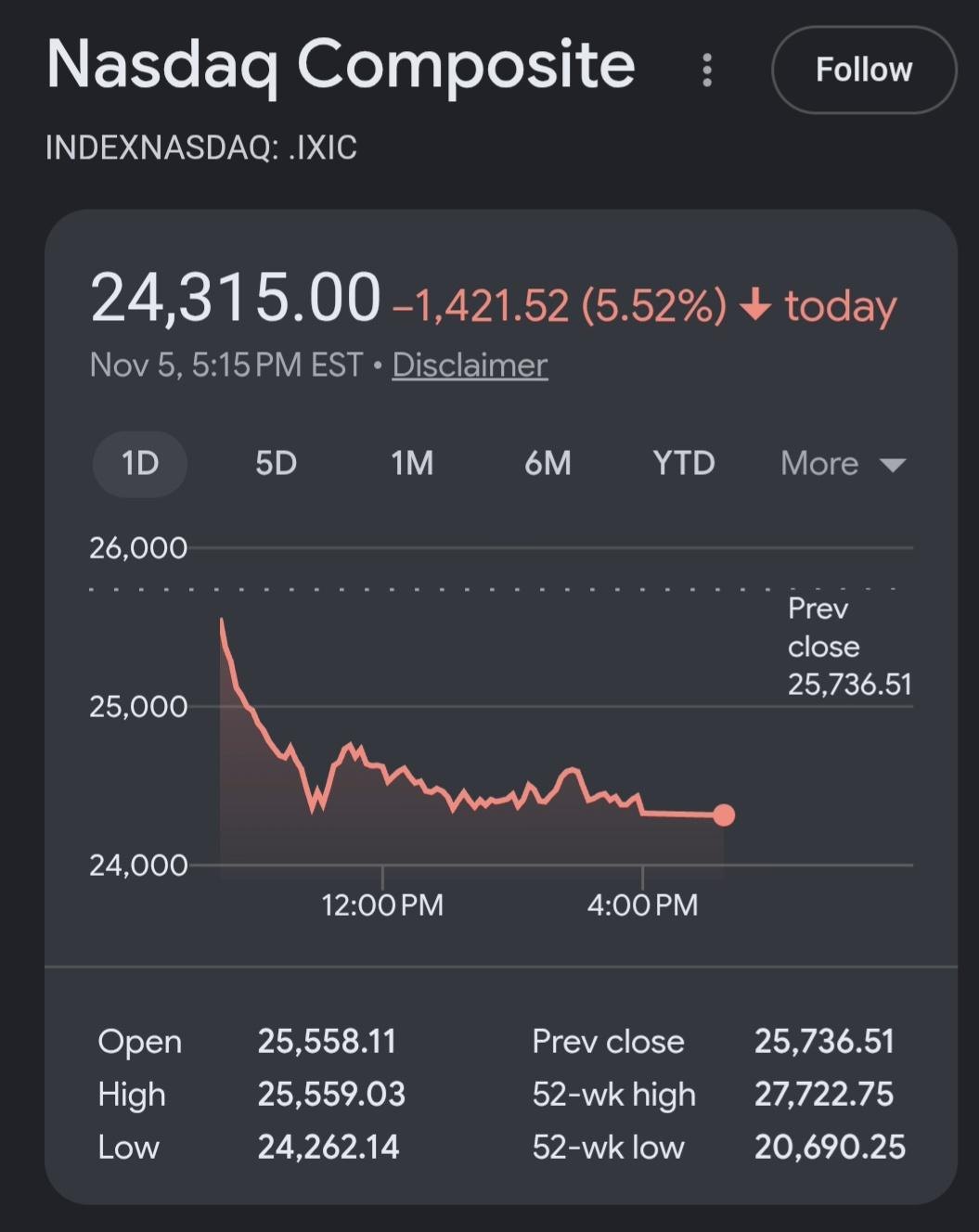
Nasdaq Composite
24,315.00
−1,421.52 (5.52%)
Nov 5, 5:15 p.m. EST
- Open
- 25,558.11
- High
- 25,559.03
- Low
- 24,262.14
- Prev close
- 25,736.51
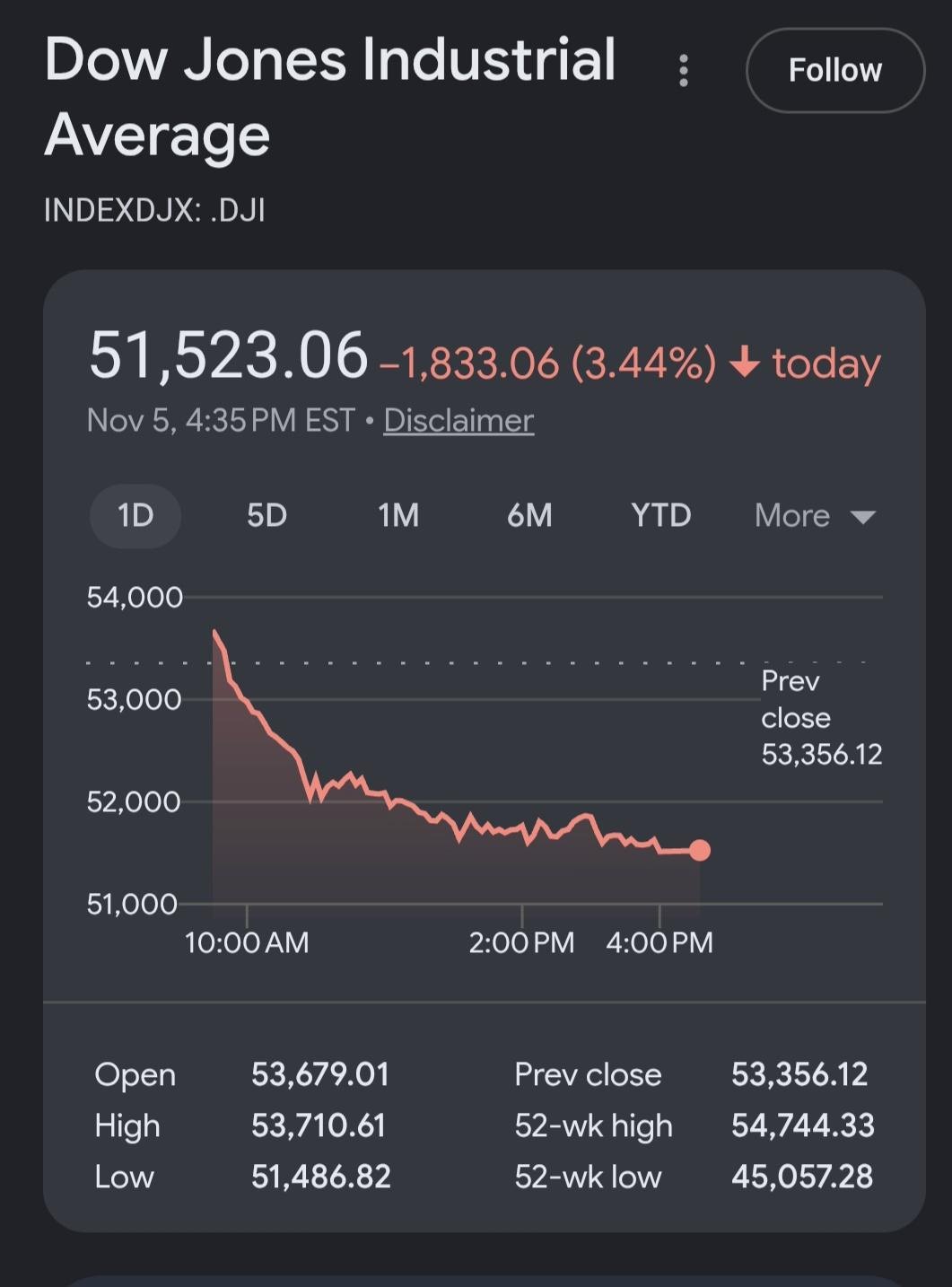
Dow Jones Industrial Average
51,523.06
−1,833.06 (3.44%)
Nov 5, 4:35 p.m. EST
- Open
- 53,679.01
- High
- 53,710.61
- Low
- 51,486.82
- Prev close
- 53,356.12
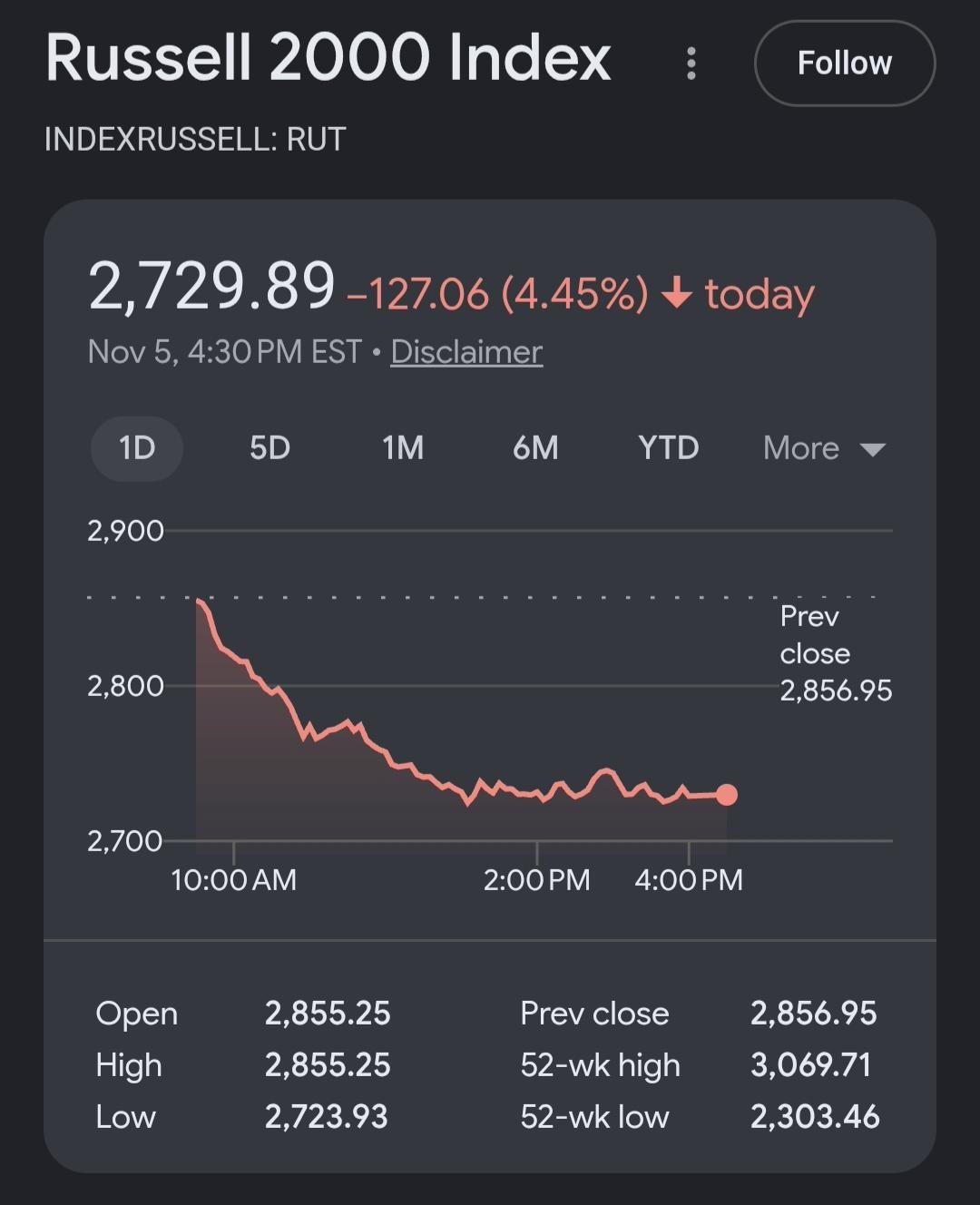
Russell 2000
2,729.89
−127.06 (4.45%)
Nov 5, 4:30 p.m. EST
- Open
- 2,855.25
- High
- 2,855.25
- Low
- 2,723.93
- Prev close
- 2,856.95
One week before, and election day
Election Day was Tuesday, November 3. One week before that was Tuesday, October 27. These are the cash closes. Thursday’s prints match the cards above to the penny.
| Index | Oct 27, a week before | Nov 3, election day | Nov 5 close |
|---|---|---|---|
| Nasdaq Composite | 26,477.81 | 25,372.01 | 24,315.00 |
| Dow | 52,377.57 | 51,786.72 | 51,523.06 |
| Russell 2000 | 2,818.87 | 2,812.45 | 2,729.89 |
From October 27 to Thursday’s close, the Nasdaq was down 2,162.81 points, 8.2 percent. The Dow was down 854.51 points, 1.6 percent. The Russell was down 88.98 points, 3.2 percent. From the election-day close alone, the Nasdaq was down another 1,057.01 points, 4.2 percent, and the Russell was down 82.56 points, 2.9 percent. The Dow was only 263.66 points, 0.5 percent, under its election-day close, because Wednesday’s 1,569-point rally is most of what Thursday erased. The Nasdaq was already down 1,105.80 points, 4.2 percent, from October 27 by the time the polls closed. Thursday did not start the break. It finished it.
The tape
Election Day was Tuesday, November 3. Wednesday the Dow rose 1,569 points. That was the session Yahoo called the best post-midterm day for the Dow in 44 years, and the Nasdaq was up 1.44 percent with it. Thursday took it back. The Dow’s loss, 1,833 points, was bigger than Wednesday’s gain. The Nasdaq Composite closed at 24,315.00, down 1,421.52 points, 5.52 percent. The Russell 2000 closed at 2,729.89, down 127.06, 4.45 percent. On the Russell card the open and the high are the same number, 2,855.25. It never traded up. The Nasdaq’s high was 25,559.03, a dollar over an open of 25,558.11. The selling started at the bell.
What broke
Wednesday’s read of a Democratic sweep of Congress was gridlock, and the indexes went up. Thursday’s read of the same result was the AI buildout. CNN and Reuters both put the session there: chipmakers and the data-center trade, not a broad story about every stock in the Dow. Reuters had the Philadelphia semiconductor index down 12 percent, its second-biggest fall on record. SanDisk was down 22 percent. Micron, AMD, and Marvell were down about 17. Nvidia was down about 9. CNN had the Nasdaq 100 down 6.36 percent, its worst day since March 2020, and the Composite’s 5.52 percent as the worst session since the April 2025 tariff announcement. The Composite finished in a correction, more than 10 percent under the October 6 high. The S&P 500 was down about 4.4 percent. Reuters said all 11 sectors fell, and tech was down 7.3 percent.
The size of it
CNN put the day’s loss in market value at roughly $2.5 trillion. Reuters put the Nasdaq’s own market cap down about $2 trillion. Motley Fool called the 1,422-point drop on the Composite the biggest single-session point loss on that index, past a 1,122-point drop on June 5, 2026. A point record is partly a function of the index being higher than it used to be. The percentage is the cleaner measure, and 5.52 percent is still the worst Nasdaq session in nineteen months. The next morning, CNN said South Korea’s Kospi opened down almost 9 percent and the exchange halted trading for 20 minutes. The cards above are the U.S. closes. The open and the high sit on top of each other. There was no second thought in the cash session.